
hdfire

Use of Inert Gas Fire Suppression Systems for Data Centers


Information Technology sector is a vital part of today's economy, providing businesses and individuals with access to critical information and services.

As such, the protection of IT assets, such as data centers and server rooms, is of utmost importance. Data centers are critical infrastructure that store and process massive amounts of sensitive data for businesses and organizations around the world. Protecting these facilities from fire is of paramount importance, as a fire could result in the loss of data, downtime, and even potential harm to human life. Inert gas-based fire suppression systems offer a reliable and safe method for protecting data centers and server rooms from fire.

National Fire Protection Association’s (NFPA) standard for clean agent fire suppression systems (NFPA 2001) includes guidelines for the use of inert gas-based systems, among other types of clean agents, in data centers and other critical facilities.

One of the key benefits of inert gas-based fire suppression systems is that they are safe for use in occupied spaces. As an alternate system to traditional fire suppression systems, which use water or other chemicals to extinguish fires, inert gas-based systems use a combination of gases, such as nitrogen, argon, and carbon dioxide, to suppress fires. These gases are non-toxic and do not leave any residue, making them safe for use in areas where people are present. Another advantage of inert gas-based fire suppression systems is that they are effective in suppressing fires quickly. The gases used in these systems are released rapidly, flooding the protected space, and reducing the oxygen level to a point where fires cannot be sustained.

This rapid suppression of fires can help prevent the spread of fire and minimize damage to IT assets, reducing downtime and ensuring business continuity. Inert gas-based fire suppression systems also offer the benefit of minimal clean-up after fire. Traditional fire suppression systems, such as those that use water or foam, can leave behind significant amounts of residue that can damage IT assets and require extensive clean-up. In contrast, inert gas-based systems do not leave any residue, eliminating the need for clean-up and minimizing the potential for damage to IT assets.

These systems use a combination of gases, such as nitrogen, argon, and carbon dioxide, to suppress fires without causing damage to the sensitive electronic equipment found in data centers. In this article, we will discuss the use of these systems in data centers and the international standards that govern their use. The use of inert gas-based fire suppression systems in data centers is governed by few international standards. The two most important standards are NFPA 2001 and ISO 14520. These standards provide guidelines for the design, installation, and maintenance of inert gas-based fire suppression systems, ensuring that they are effective and safe for use in data centers. NFPA 2001 is the standard for clean agent fire suppression systems. It provides guidelines for the design, installation, and maintenance of fire suppression systems that use clean agents, including inert gases. This standard ensures that the systems are effective in suppressing fires while minimizing damage to the equipment and the environment. ISO 14520 is the international standard for gaseous fire-extinguishing systems. It provides guidelines for the design, installation, and maintenance of fire suppression systems that use gaseous agents, including inert gases.

One should understand that it is very important to conduct a thorough fire hazard assessment, select the appropriate gas, ensure the room’s integrity, design an effective piping network, consider the gas storage requirements, and design an effective alarm and control system. These factors are critical to ensuring the system’s effectiveness in protecting the intended space from fire.

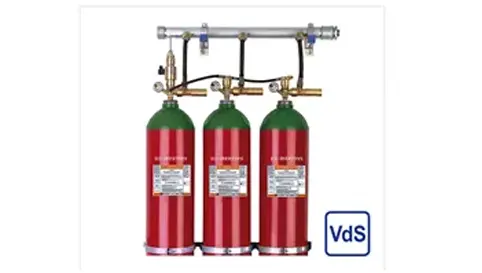
HD Fire Protect offers the HD Inertsys inert gas fire suppression system as one of its flagship products. The system is designed to quickly extinguish fires in areas where water-based fire suppression systems are not practical or effective. The HD Inertsys system uses a combination of argone, nitrogen and CO2 gases, which are stored in high-pressure cylinders (200/300 bar) and released through a network of piping and discharge nozzles. One of the key features of the HD Inertsys system is its ability to quickly suppress fires while minimizing damage to the protected space and its contents. The system works by reducing the oxygen concentration in the protected area to a level that cannot sustain combustion. The system is effective in suppressing fires involving Class A, B, and C combustibles, including electrical fires.

The HD Inertsys system is designed to be environmentally friendly, with zero ozone depletion potential and zero global warming potential. The system is also safe for use in occupied spaces and does not leave any residue or cause any damage to IT assets. The HD Inertsys system is available in various sizes and configurations, making it suitable for a wide range of applications, from small server rooms to large IT data centers and industrial facilities. The system is designed and manufactured with VdS Approval. Overall, the HD Inertsys inert gas fire suppression system is a reliable and effective solution for protecting critical assets from fire, and it has been widely adopted by various industries worldwide.




Disclaimer

THESE MATERIALS ARE NOT DIRECTED AT OR INTENDED TO BE ACCESSED BY PERSONS LOCATED OUTSIDE INDIA. IMPORTANT: You must read and agree with the terms and conditions of the following disclaimer before continuing. The following disclaimer applies to the draft red herring prospectus of HD Fire Protect Limited (the “Company”) dated September 24, 2025 (the “Draft Red Herring Prospectus”) filed with the Securities and Exchange Board of India (“SEBI“), BSE Limited and National Stock Exchange of India Limited (together, the “Stock Exchanges”), as well as the audio visual film of the Company (the “IPO AV”), in relation to the proposed initial public offering of the equity shares of face value of ₹5 each of the Company (“Equity Shares”) in India (“Offer”). You are advised to read this disclaimer carefully before reading, accessing or making any other use of the Draft Red Herring Prospectus and the IPO AV. In accessing the Draft Red Herring Prospectus and/or the IPO AV, you agree to be bound by the following terms and conditions, including any modifications to them from time to time. THE DRAFT RED HERRING PROSPECTUS IS BEING MADE AVAILABLE ON THIS WEBSITE IN ELECTRONIC FORM SOLELY TO COMPLY WITH THE SECURITIES AND EXCHANGE BOARD OF INDIA (ISSUE OF CAPITAL AND DISCLOSURE REQUIREMENTS) REGULATIONS, 2018, AS AMENDED (“SEBI ICDR REGULATIONS”). THE IPO AV IS BEING MADE AVAILABLE ON THIS WEBSITE IN ACCORDANCE WITH CIRCULAR ON “AUDIOVISUAL (AV) PRESENTATION OF DISCLOSURES MADE IN PUBLIC ISSUE OFFER DOCUMENTS” DATED MAY 24, 2024, ISSUED BY SEBI Each of the Draft Red Herring Prospectus and the IPO AV is directed at, and is intended for distribution to, and use by, residents of India only. No part of the contents of the Draft Red Herring Prospectus and the IPO AV may be copied or duplicated in any form by any means or redistributed. Failure to comply with this disclaimer may result in a violation of the applicable laws. If you access the Draft Red Herring Prospectus and/or the IPO AV, you agree not to forward, deliver or distribute them, in whole or in part, to any person outside India. The Draft Red Herring Prospectus and the IPO AV are for information purposes only and do not constitute, and should not be construed as, directly or indirectly, an offer or invitation to sell or the solicitation of an offer or invitation to purchase any Equity Shares in any jurisdiction. Any such offer or solicitation, if made, would only be made pursuant to the Red Herring Prospectus (“RHP”), which may be filed with the relevant Registrar of Companies in the future (if you are in India) or the RHP and the preliminary international wrap (which contains, among other things, the selling restrictions for the Offer outside India) if the investor is outside India. No person outside India is eligible to bid for Equity Shares in the Offer unless that person has received the preliminary offering memorandum for the Offer, which comprises the Red Herring Prospectus and the preliminary international wrap.   Potential investors should note that investment in the Equity Shares involves a high degree of risk and for details relating to such risks, please refer to the RHP (when available), including the section titled “Risk Factors”, and for potential investors outside India and the preliminary international wrap (when available).   The Equity Shares offered in the Offer have not been and will not be registered, listed or otherwise qualified in any jurisdiction except India and may not be offered or sold to persons outside of India except in compliance with the applicable laws of each such jurisdiction. In particular, the Equity Shares offered in the Offer have not been and will not be registered, listed or otherwise qualified in any jurisdiction except India and may not be offered or sold to persons outside of India except in compliance with the applicable laws of each such jurisdiction. In particular, the Equity Shares offered in the Offer have not been and will not be registered under the U.S. Securities Act of 1933, as amended, or the securities laws of any state of the United States and may not be offered or sold in the United States, except pursuant to an exemption from, or in a transaction not subject to, the registration requirements of the U.S. Securities Act and applicable state securities laws. The Equity Shares offered in the Offer are being offered and sold only outside the United States in “offshore transactions” as defined in and in reliance on Regulation S under the U.S. Securities Act. Ambit Private Limited, Anand Rathi Advisors Limited and IIFL Capital Services Limited (formerly IIFL Securities Limited) (together, the “Book Running Lead Managers”) are the book running lead managers for the Offer and they and their respective affiliates, directors, officers, agents, representatives, advisers and employees do not accept any liability whatsoever, direct or indirect, that may arise from the use of the information contained on this website. The information in the Draft Red Herring Prospectus and the IPO AV is as of the date thereof and none of the Company, the Promoter Selling Shareholders, the Book Running Lead Managers or their respective affiliates, directors, officers, agents, representatives, advisers or employees are under any obligation to update or revise the Draft Red Herring Prospectus and the IPO AV to reflect circumstances arising after the date thereof. You are reminded that documents transmitted in electronic form may be altered or changed during the process of transmission and consequently, neither the Company, the Book Running Lead Managers nor any of their respective affiliates, directors, officers, agents, representatives, advisers or employees accepts any liability or responsibility whatsoever in respect of alterations or changes which have taken place during the course of transmission of the Draft Red Herring Prospectus and the IPO AV in electronic format. You are accessing this website at your own risk and it is your responsibility to take precautions to ensure that it is free from viruses. Capitalised terms used herein but not defined herein have the meaning given to those terms in the Draft Red Herring Prospectus. Due to legal restrictions, access to this part of this website is only available to residents of India from within India.  If you are not in India, please exit this webpage. Confirmation of your acceptance of the terms and conditions By clicking on the “I Confirm” button below you represent to the Company that: 1. You have read the disclaimer set out above and you agree to be bound by its terms; and 2. You are a resident of India and are located in India. If you cannot make these confirmations, you must press the button marked “I Do Not Confirm”.