
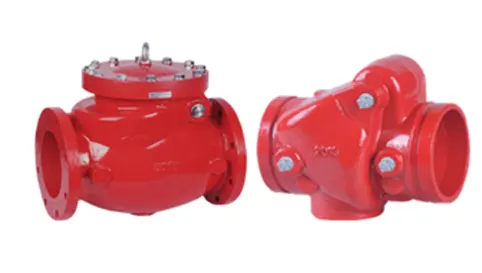
In modern fire protection systems, reliability, longevity, and compliance are non-negotiable. Every component, from the fire pump to the final sprinkler head, plays a critical role in safeguarding property and lives. Among these, the swing check valve is a fundamental yet often underappreciated component that ensures unidirectional water flow, system integrity, and code compliance.
This article explores the working principle, material considerations, coating technology, and global usage of swing check valves with specific focus on their importance in fire protection service.
What Is a Swing Check Valve?
A swing check valve is a type of mechanical backflow prevention device designed to allow fluid flow in one direction while automatically preventing reverse flow. It features a hinged disc that swings open with forward flow and closes tightly when flow stops or reverses, thereby ensuring reliable backflow protection.
This passive, self-operating mechanism requires no manual intervention, making it highly suitable for life safety and fire protection systems. Swing check valves are available with flanged or grooved ends for convenient and flexible installation. They are typically rated for up to 300 psi working pressure, making them ideal for high-performance fire suppression applications.
Why Are Swing Check Valves Essential in Fire Systems?
In fire protection systems, especially fire sprinkler and standpipe networks, maintaining system pressure and direction of flow is vital. Swing check valves support this by:
- Preventing Reverse Flow
Backflow can contaminate water supplies, damage fire pumps, or reduce system pressure. Swing check valves automatically seal off this risk. - Maintaining System Readiness
In wet-pipe sprinkler systems, stored pressure must be preserved to ensure instant activation. Check valves help retain water in risers and mains. - Protecting Pumps and Components
Reverse water surge can damage fire pumps and pipework. Check valves guard against hydraulic shock and mechanical wear. - Eliminating Siphoning or Drain-Back
Once deployed, check valves prevent unintentional draining of fire mains or sprinkler headers.
Material Selection for Durability
Swing check valves are constructed from robust materials suited to demanding fire service conditions:
- Ductile Iron: Offers high tensile strength and durability
- Bronze/Brass: Used in humid or marine environments for corrosion resistance
- Stainless Steel: Ideal for aggressive or chemical-rich atmospheres
- Cast Iron with Epoxy Coating: Common in clean water systems requiring cost-effective protection
End connections are typically grooved or flanged for ease of installation and compliance with NFPA guidelines.
Importance of Fusion Bonded Epoxy (FBE) Coating
A critical aspect of a swing check valve’s durability in fire systems lies in its protective coating. The industry-standard for fire valves is a red Fusion Bonded Epoxy (FBE) coating, not just for aesthetics, but for essential performance benefits:
- Corrosion Resistance: Prevents rust and degradation, especially in underground or coastal installations
- Chemical Resistance: Withstands cleaning agents, chlorinated water, or treated supply lines
- Mechanical Protection: Adds abrasion resistance and reduces internal buildup
- Thermal Stability: Maintains coating integrity under elevated temperatures – valves used in fire systems are often exposed to radiant heat or surge conditions
- Colour Coding for Safety: Red coating aligns with NFPA norms and allows easy identification of fire system valves during inspections
For example, swing check valves manufactured by HD Fire Protect come coated in red FBE and are rated for service up to 100°C, ensuring thermal and corrosion resistance in critical fire protection roles.
Standards and Certifications
Swing check valves must comply with global standards to ensure safe integration into fire protection systems. Key certifications include:
- NFPA 13: Sprinkler System Installations
- NFPA 14: Standpipe Systems
- NFPA 20: Fire Pump Installations
- UL (UL Solutions) and FM (FM Approvals)
These certifications validate a valve’s performance, reliability, and suitability for use in life-safety applications.
Key Specification Considerations
When specifying swing check valves for fire systems, engineers and contractors should evaluate:
- Flow Characteristics (Cv Value): Ensures minimal pressure loss
- Installation Orientation: Most valves are designed for horizontal placement – verify suitability before vertical installs
- Operating Conditions: Humidity, temperature, and water quality all affect material and coating choice
- Access for Maintenance: Options with inspection ports or removable covers simplify servicing
- Water Hammer Mitigation: Soft-seated or damped designs can minimize hydraulic shock in large systems
Global Adoption and Relevance
Swing check valves are used worldwide in diverse applications — from petrochemical plants to residential towers. Their relevance spans geographies:
- United States & Canada: Extensive adoption due to strict NFPA enforcement
- India, Singapore, Malaysia: Growing demand for certified components in urban and industrial growth corridors
- Saudi Arabia, UAE, Qatar, Oman, Kuwait: Integral to oil & gas infrastructure, commercial complexes, and airports
- Indonesia, Vietnam, Mexico, Colombia, Peru: Rapid urbanization and increased investment in smart buildings and fire-safe infrastructure
In each region, the need for reliable, corrosion-resistant, standards-compliant swing check valves is driving widespread adoption.
Maintenance and Inspection
As per NFPA 25, swing check valves should be:
- Visually inspected annually
- Flow tested periodically
- Maintained clean and debris-free, especially in untreated water systems
- Checked for correct orientation and closure performance
Routine maintenance not only extends valve life but also ensures compliance and operational readiness during fire emergencies.
In fire protection systems, swing check valves are not just flow devices, they are life safety components. By preventing reverse flow, maintaining pressure, and withstanding harsh conditions, these valves form a crucial link in the chain of fire suppression reliability.
With advancements such as Fusion Bonded Epoxy coatings, high-temperature resistance, and global certification, modern swing check valves are designed for long-term performance in even the most demanding fire environments.
Manufacturers such as HD Fire Protect and others continue to support fire safety worldwide with valves that meet stringent technical, environmental, and regulatory requirements, ensuring performance that professionals can trust.